It may seem unfair to pick on mild mannered Obama's views on war and taxes. But by continuing Bush/Cheney-era policies while dressed as a democrat, he has betrayed the people who voted for him and even angered those who did not. The only ones who are happy are the clandestine services and business interests that got him (s)elected.
Taxes are an old money-raising scheme. Buddhism makes reference to them in numerous places. Why should this be so? The breadth of topics the Buddha covered is astounding leading Bhikkhu Bodhi to comment on the astonishing modernity of the information.
The Buddha knew as much as the number of leaves in a forest while only revealing in detail a handful. This was his own simile, explaining that his focus was enlightenment and extending the duration of the Dharma (the teaching of the path-practice that leads to enlightenment) in the world.
It is because of the latter that we have pearls of wisdom regarding many topics embedded in the discourses or sutras. Lay followers are guided to a good life, one not aiming at nirvana but at worldly success here and fortunate future rebirths hereafter, in the "Advice to Householders" (DN 31).
ANANDA'S FORMER LIVES
Wisdom Quarterly explanation from Hellmuth Hecker, ANANDA: THE GUARDIAN OF THE DHAMMA (BPS)
A summary of Ananda's former lives shows that he was only seldom a "deva", seldom an animal, but most often a human. One can see that his most important aspect was as a human, whereas his exemplary and infamous brothers, Anuruddha and Devadatta, had almost always been a "deva "and very often an animal, respectively.
Ananda's extraordinarily close connection to the Buddha is revealed by the fact that he was often his brother in former lives. The examples of former lives given here will be mainly those which exemplify that he, too, had to exert himself to attain virtue.
Hypocrisy is to be expected when the US figurehead is follow orders from unseen movers and shakers (the military-industrial complex with help from big pharmaceuticals and the entertainment arm of public relations. It's not the "change" we voted for, but it is the Brave New World Order we expected.
BIRTH STORY ("JATAKA") 498. Ananda and the Bodhisatta (the Buddha-to-be) were born as cousins among the outcasts called "candalas". Their job was the fumigation of malodorous places [or possibly sweepers]. In order to escape the contempt they were held in, they disguised themselves as young brahmin caste men who together went to the University at Takkasila (Taxila) to study and escape their low caste.
After the Bodhisatta became a great success and Ananda lagged behind in his studies, their deception was discovered. They were beaten by their fellow students and chased out of college. But a wise and kindly brahmin ordered the brahmin students to stop and advised the outcasts to become ascetics, the only upwardly mobile avenue open to them in ancient Indo-Afghanistan/Pakistan (a region in the western frontier of ancient India called Gandhara).
They followed this advice, and in due course passed away. They were reborn together as animals [some say as a karmic result or "punishment" for their deception, but this is highly speculative since karma works in mysterious ways], namely as offspring of a doe. They were inseparable and died together with by the single arrow of a hunter. In the next life [which the Bodhisatta remembered and the Buddha recounted in this birth tale] they were sea hawks and again died together at the hands of a hunter.
With this, their existences below the fortunate human level came to an end. Ananda was born as the son of a king and the Bodhisatta as the son of the priest at court. While Ananda held the higher position in a worldly sense, the Bodhisatta had more inner abilities. For one thing, he could remember all three of their former lives, whereas Ananda could only remember his former human life as an outcast in college. At the age of 16, the Bodhisatta became a sincerely striving ascetic, while Ananda assumed the throne.
Many years later when the time was right and the king amenable to advice, the Bodhisatta visited him. He praised the happiness born of asceticism and explained the unsatisfactoriness of the world of the senses. Ananda admitted that he realized this, but confessed that he could not let go of his desires. He was held fast like an elephant in a muddy watering hole.
Then the Bodhisatta advised him that even as a king he could practice virtue -- such as not levying unjust taxes, and supporting wandering ascetics and brahmin priests. He also taught him that when hot passions arose in him, he could remember his mother. He could recall how he had been completely helpless as a baby, and if his mother had not brought him up, he would never have become king. Thereupon Ananda resolved to become an ascetic; both attained to the "brahma" (divine) realm.
"Mahamuni" ("Great Sage") statue created by extraterrestrial "devas."
WHAT ARE UNJUST TAXES?
But what are unjust levels of taxation for a ruler? One answer comes from Burmese Theravadan work. This translation was compiled by Roger Bischoff in Buddhism in Myanmar: A Short History:
The Visit to Arakan
In Dhannavati, whose walls are still partially visible today, the Mahamuni temple is located on the Sirigutta hill. In this temple, for over two millennia, the Mahamuni image was enshrined and worshipped. The story of the Mahamuni image, at one time one of the most revered shrines of Buddhism, is told in the Sappadanapakarana, a work of a local historian.
King Candrasuriya, who ruled Dhannavati, on hearing that a Buddha had arisen in India, desired to go there to learn the Dharma. The Buddha, aware of his intention, said to Ananda: "The king will have to pass through forests dangerous to travelers; wide rivers will impede his journey; he must cross a sea full of monsters. It will be an act of charity if we go to his dominion [modern Burma], so that he may pay [his respects] without risking his life."
So the Buddha went there and was received with great pomp by King Candrasuriya and his people. The Buddha then taught the FIVE AND EIGHT PRECEPTS and instructed the king in the ten kingly duties, namely:
* universal beneficence
* daily paying respect
* showing mercy
* TAXES OF NOT MORE THAN A TENTH PART OF THE PRODUCE
* justice
* punishment without anger
* the support of his subjects as the Earth supports them
* the employment of prudent commanders
* the taking of good counsel
* avoiding pride.
The Mahamuni Pagoda in Mandalay, Burma housing the magnificent figure.
The Buddha remained for a week. And on preparing for his departure, the king requested that he leave an image of himself so they could pay honor to him even in his absence. The Buddha consented to this and Sakka, King of the [near-Earth extraterrestrial] "Devas", himself formed the image with the metals collected by the king and his people.
It was completed in one week. And when the Buddha breathed onto it, the people exclaimed that now there were indeed two Buddhas, so alike was the image to the great sage. Then the Buddha made a prophecy addressing the image: "I shall pass into nirvana in my 80th year, but you will live for 5,000 years, which I have foreseen as the duration of my Teaching (Dharma)."
[This puts us a little past the halfway mark because the Buddha passed into nirvana sometime between 2,600 to 3,000 years ago. This year, 2011, marks the 2,600th year since his enlightenment.]Bush understood the revenue generating potential of war. It provides an excuse for endless taxation and fewer services that people fear to argue with. Peace is rebellious because we have been convinced by a PR campaign that war is "patriotic." Pres. Obama now apes and adopts all the same postures and platforms as Bush infuriated everyone by doing.
Keywords: stonehenge found batters making your buddhist isidasi kung buddhism film made video buddha made celtic buddhism kells intl conference values love gods and goddesses free magic love spells candle magic for love lucid dreaming mask free ancient love spells dangers of astral projection
Buddhist monks on "Asanha Puja" Day, the eve of Buddhist Lent, in Nakhon Pathom province, outerBangkok, 7-26-10
VASSA (the annual Rains Retreat) is observed as it has been from the time of the Buddha. The rainy season in northern India led to the institution of a monastic rule to go into retreat for intensive practice. Buddhist recluses were originally "wandering ascetics" ("samanas"). But the rainy season meant a burst of new life -- crops, amphibians, insects, and sprouts all covered the land -- all of which would be harmed if wanderers were to tread on them.
So like other ascetic traditions of his day, the Buddha responded to requests to have his disciples take up temporary residence in one location rather than wandering about. This period is utilized for intensive meditation practice, study, and teaching. Lay Buddhists visit temples and abbeys to practice as well, sometimes adopting Eight Precepts for the day.This tradition is observed throughout Los Angeles and other ethnically diverse cities with THERAVADA temples. The Los Angeles Buddhist "Vihara" (a Sri Lankan monastery) in Pasadena has weekly Dharma sermons, free meals ("dana"), and meditation instruction for visitors. These are all echoes of a much more vibrant living tradition in Sri Lanka, Thailand, Burma, Cambodia, Laos, and other Buddhist countries that keep the original Indian ideal going.
There it is a big deal that monks will be taking up residence. A special ceremony was held in each American Theravada temple this past weekend (in accordance with the lunar calendar) "inviting" monks to observe the Rains Retreat for the next three months. The Dhammakaya Thai Buddhist temple also temporarily ordained men wishing to observe "Vassa" as monastics.
* The connections to be drawn with LENT are no coincidence. Customary acts of self-purification, for example ALMSGIVING and fasting, in Christianity were directly borrowed from Eastern practices.
Keywords: ahead hinduism rock buddhism rock made buddhist skateboarding video buddha tour california lies hinduism world tour california civilization buddhist lore paulina tarot alchemical tarot astral travel courses learn astral projection online tarot deck gilded tarot free tarot card reading
Statue of the Buddha in the Earth touching mudra" ("Bhumisparsha"), the most beautiful in the world
The Buddhist photographer WONDERLANE (wonderlane@gmail.com) plans to attend a third Kalachakra in Washington D.C. in July of 2011 with a plan to honor a commitment to practice.
BRIEF HISTORY OF SAKYA MONASTERY
Alexander Berzin (berzinarchives.com)In the Manjushri Root Tantra, the Buddha is said to have prophesied that a Sakya Monastery would cause his teachings to flourish in the Land of Snows [Tibetan plateau]. It is said the site of this monastery was also prophesied by Guru Rinpoche Padmasambhava. Several "stupas" [burial mounds for the relics of enlightened individuals and revered teachers] had already been built at the monastery's future location, when Atisha (982-1053) stopped there in 1040.
He saw on the mountainside a syllable "Hrih"," seven "Dhih"," and one "Hung" and prophesied that an incarnation of Avalokiteshvara, seven of Manjushri, and one of Vajrapani would grace this site. In 1073, Konchog-gyelpo (1034-1102) of the Kon ('Khon) family established the Pelden Sakya Monastery ("gompa") in Tsang province in central Tibet. The monastery, and subsequently the tradition he founded, derived its name from the color of the soil of its location. "Sakya" means literally "gray earth."
Keywords: 1459 buddha facelift buddhism kells film father buddhist story lies hinduism ways enlightened june full moon religious days thailand days thailand is astral travel real do as thou wilt alyster crowley the rituals thumbs up sir john dee astral projection books
Ven. Chandananda (free weekly meditation and Dharma classes, Tuesdays 7:00-8:30 pm, Los Angeles Buddhist Vihara, Pasadena, CA)
Four Protective Meditations
There are four practices that protect and advance an the individual who undertakes them. These four are: (1) Recollection of the Buddha, (2) loving-kindness, (3) the unattractiveness of the body, and (4) mindfulness of death. The virtuous meditator is wise to cultivate these four protections. An intelligent approach is to first develop the recollection of the Buddha ("buddhanussati") by contemplating the great sage's excellent unbounded qualities:
Recollecting the Buddha
1. Destroyed he alone all the
defilements without a trace
Fully purified was his mental-continuum,
And he was ever worthy of offerings.
2. Having perfectly understood
all temporal phenomena in every way
The sage alone
attained to omniscience.
3. With knowledge born of insight,
with conduct born of virtue,
endowed with accomplishments was he,
as the sun in the sky.
4. He attained th best state.
Never in vain were his words.
Knower in full of the threefold [sensual,
fine material, immaterial] world was he.
5. By his ocean-like virtue
highest of all beings became he
and with methods diverse
the tameable he tamed.
6. For the entire world he alone,
teacher of all beings became.
The blessed Noble One of qualities supreme
a treasury of all [ten] perfections was he.
7. He was wise in all ways
towards all beings compassionate
For his own and the good of others as well
Further high virtue had he.
THE BUDDHA
In about the 6th century B.C.E., Siddhartha Gautama was born into a royal family. When he was a young adult his experiences with the outside world drove him to seek out a greater understanding of life and spiritual fulfilment.
Keywords: rains retreat buddha california going buddhists sarah gradual training buddha burma first generation america birthday angeles jewish muslim take mythology greek gods and goddesses love spells casters astral project ancient gods and goddesses names japanese gods and goddesses and astral projection
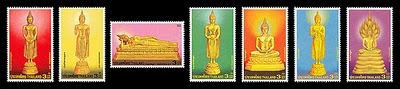
Buddhist customs in THAILAND have been influenced by many Hindu beliefs. The association of a color with each day, for example, is one such custom. It is illustrated by this series of stamps celebrating important Buddhist religious days. Thais attach particular significance to the color of the day on which they were born.
2000: "Asalha-"PUJA Day, Red - Sunday
2001: "Visakha-puja" Day, Yellow - Monday
2002: "Magha-puja" Day, Pink - Tuesday
2003: "Asalha-puja" Day, Green - Wednesday
2004: "Visakha-puja" Day, Orange - Thursday
2005: "Magha-puja" Day, Blue - Friday
2006: "Visakha-puja" Day, Purple - Saturday
"Asalhapuja" Day is the full moon day of the 8th lunar month (the day following the full moon). This day commemorates THE BUDDHA'S FIRST SERMON following his enlightenment. The sermon was given to the FIVE ASCETICS in the forest. The Buddha taught them to follow the "Middle Way" -- to avoid either extreme of sensual indulgence or mortifying asceticism, lust and penance. After this sermon the senior ascetic, A~n~na-KONDA~n~nA, was ordained as the first Buddhist monk. He became the foundation of the Buddhist Monastic Order, the "Sangha.
"Visakhapuja" Day is the full moon day of the 6th lunar month. This day commemorates VESAK (the birth, enlightenment, and NIRVANA-IZATION of the Buddha, all of which occurred on the full moon day of the Indian month of Vesakha). All these events occurred years apart but on the same day: The Buddha was born on this day in 623 BC, attained enlightenment in 588 BC, and died in 543 BC (passed into final nirvana). Of course, the dates are disputed, most famously by DR. PAL.
"Maghapuja" Day is the full moon day of the 3rd lunar month. This SANGHA DAY commemorates the spontaneous assembly of 1,250 disciples of the Buddha nine months after his enlightenment. Each of the disciples had been ordained directly by the Buddha. The meeting took place 44 years before the start of the Budddhist Era (587 BC). The Buddha gave a sermon at this meeting, expressing the principal ideas of his teaching and how they apply to everyday life.
On all of these days Thai Buddhists usually give alms to monastics, meditate, and otherwise make merit at temples around the country.
Keywords: history afghanistan june full buddha birthday 2010 quake victims buddhist conference values buddhist monks earthquake secret film point view family tree of gods and goddesses real astral projection obe out of body experience important greek gods and goddesses love spells casters astral projection robert monroe